
Bucket List Species
Goonch Catfish
World Record
165 lb 5 oz (75 kg)
Ramganga River, India
Distribution
Indian Subcontinent
Indus, Ganges-Brahmaputra and peninsular river systems
Season
March – May
October – November
Techniques
Heavy Bait Fishing
Bottom rigs, big baits and strong hooks

Goonch Catfish
Species Overview
The goonch or giant devil catfish is a large predatory catfish of the Indian subcontinent and one of the most formidable fish found in Asia’s great river systems. Long known to anglers as Bagarius yarrelli, it is now generally classified as Bagarius bagarius and belongs to the Sisoridae family of catfishes adapted to life in fast-flowing water.
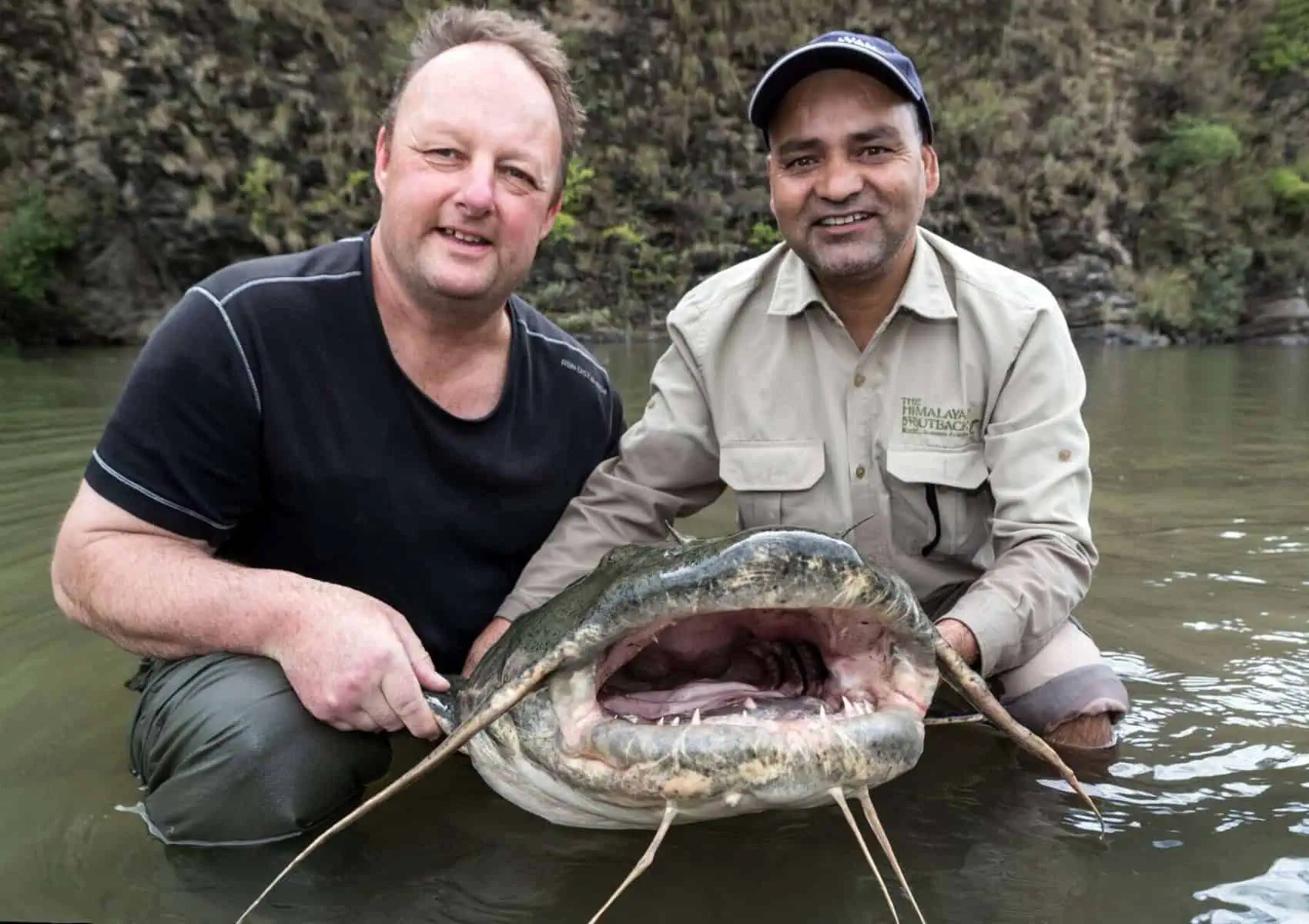
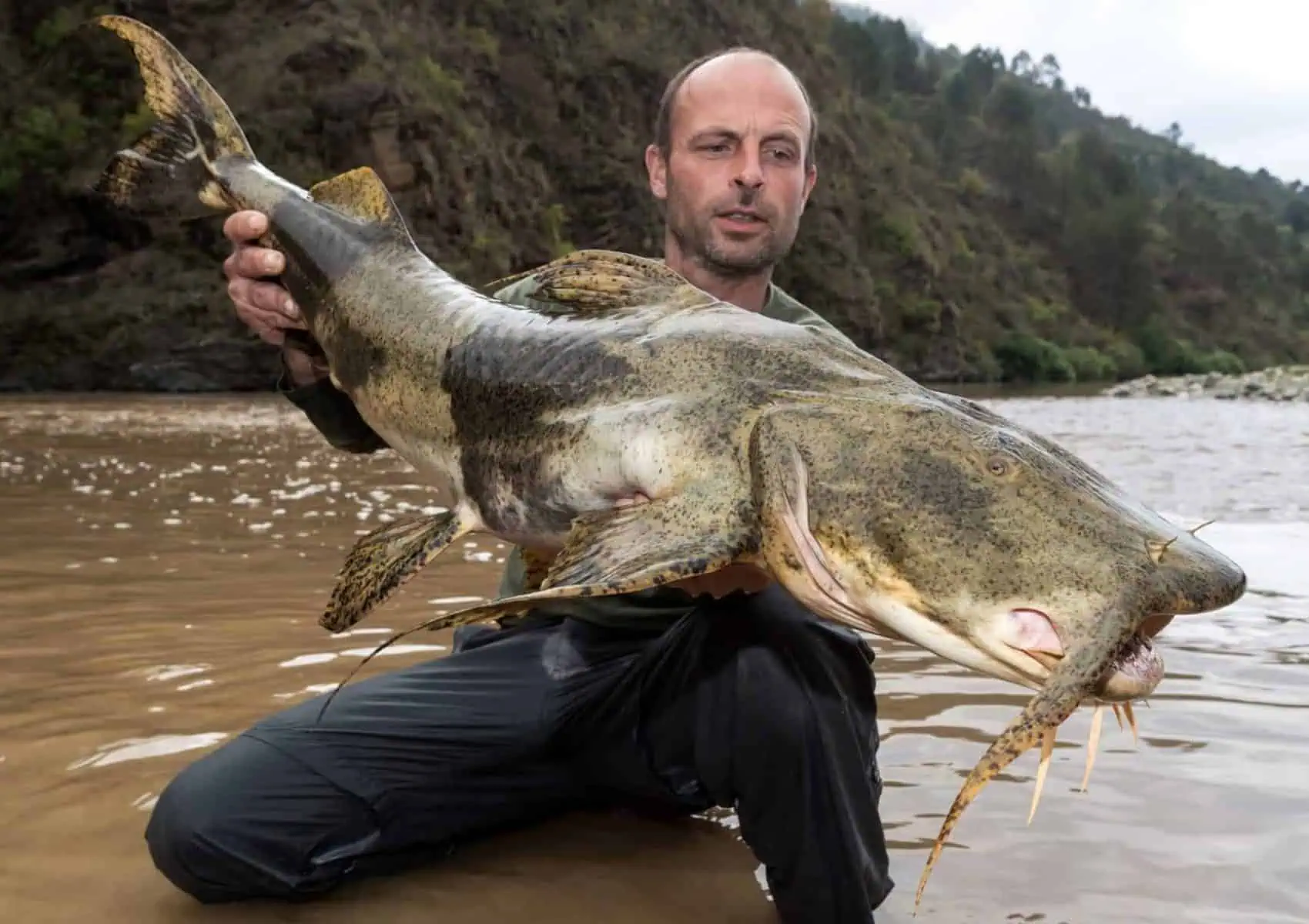
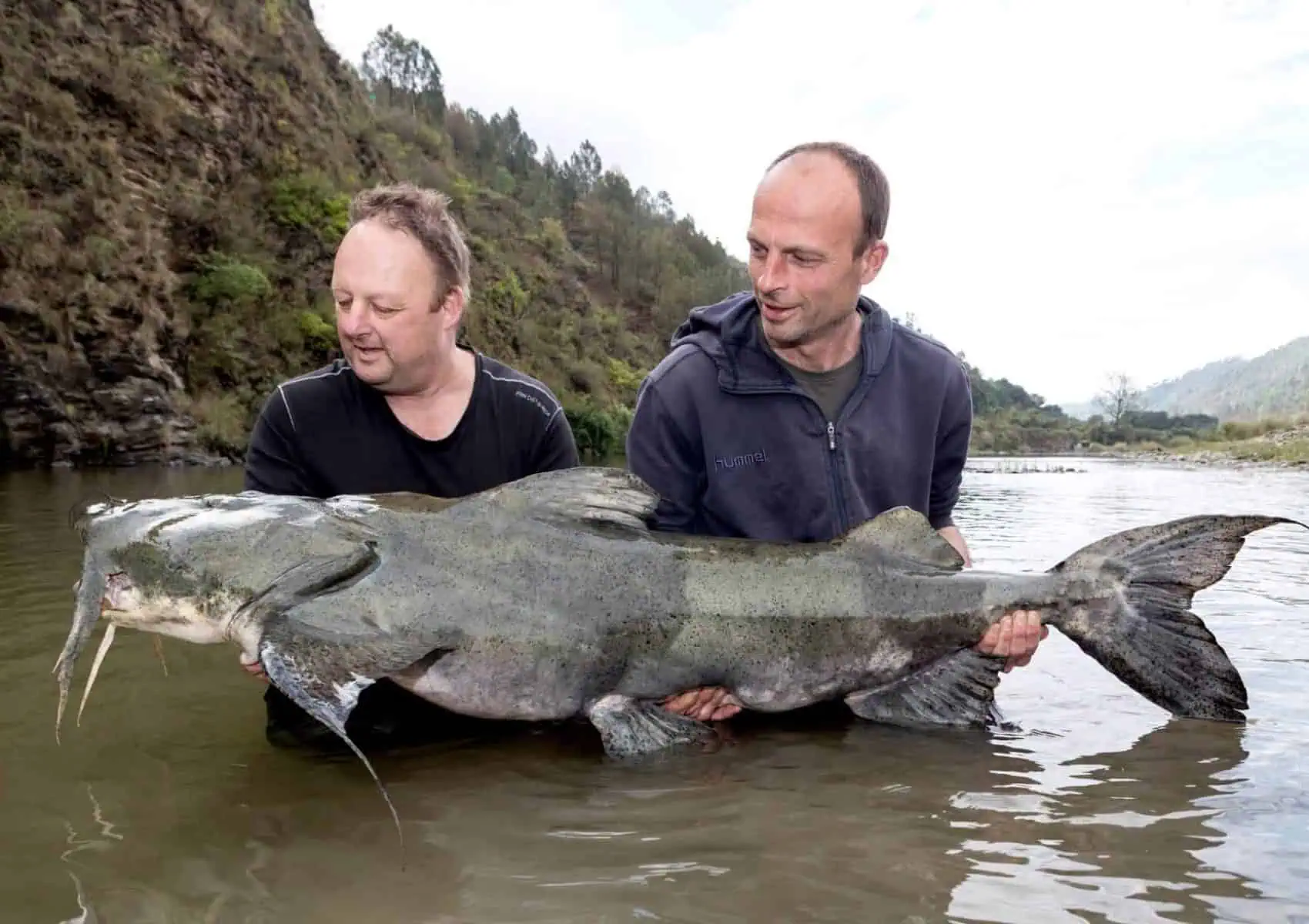
Everything about the goonch reflects its river environment. Its broad, flattened head, low-set body and powerful pectoral fins help it hold close to the bottom in strong current. Mottled shades of olive, brown and grey provide excellent camouflage among boulders, gravel and submerged ledges, while its wide mouth, sensory barbels and well-developed teeth equip it to hunt fish, crustaceans and other aquatic prey. Large goonch favour deep pools, rocky channels and current breaks where they can remain sheltered while waiting for food to be carried within striking range. When hooked, they use their considerable weight, the force of the river and every available obstruction to resist the angler.
Their combination of mystery, brute strength and remote Himalayan scenery has made the goonch one of freshwater fishing’s most compelling expedition targets. The IGFA All-Tackle world record currently stands at 165 pounds 5 ounces, or 75 kilograms and was caught by Jakub Vágner from India’s Ramganga River on 6 March 2009.
Why goonch make our list
Size alone does not earn a fish a place among the world’s great angling targets. Plenty of freshwater species grow large.
First, there is the habitat. Goonch water is rarely convenient. Productive rivers cut through Himalayan foothills, forested gorges, isolated valleys and stretches where roads offer only limited access. Reaching the best pools may involve rafting, rough vehicle transfers, long walks and several nights in mobile river camps.
Then there is the uncertainty. Goonch are not encountered in dense concentrations, and a successful expedition involves as much luck as it does skill. Hours of inactivity are normal and single meaningful bite can define an entire trip.
Finally, there is the fight. A hooked goonch does not make spectacular leaps. Its strength lies in mass, leverage and intimate knowledge of the bottom. Large fish use the current and frequently attempt to settle behind rocks or move into submerged structure. The battle is often in preventing the fish from reaching a position from which it cannot be moved.
Distribution and Habitat
The giant South Asian goonch is restricted to the Indian subcontinent. Its range includes major river systems associated with the Indus and Ganges-Brahmaputra basins, together with parts of peninsular India. Fish previously identified under the same name in much of Southeast Asia are now divided among other species of Bagarius, including B. lica and the much smaller B. vegrandis.
Within its South Asian range, the goonch is a fish of substantial rivers. It is associated with rocky channels, rapids, deep pools, fast runs and the quieter water immediately beside powerful current. Large individuals are particularly suited to places where depth and structure occur close together.
The most obvious pool is not always the most productive. A featureless hole may provide depth but little opportunity for a predator to intercept food. More promising areas include the tail of a rapid, the base of a rock wall, an outside bend, a submerged ledge or a deep pocket immediately below a boulder-strewn run.
Water colour can range from clear green to heavily stained, depending on the river, season and recent rainfall. Clear conditions make it easier for guides to interpret the riverbed, but slightly coloured water can encourage fish to move and feed more confidently. Sudden rises, particularly during the monsoon transition, can transform a manageable river into an unsafe and unfishable torrent.
The goonch’s flattened profile is an adaptation to this demanding environment. It allows the fish to remain close to the bottom, where water velocity is reduced by friction and broken by rocks. Its broad head and pectoral fins contribute to a shape that appears almost purpose-built for life beneath a rapid.
Best locations for goonch
The Ramganga River, India
The Ramganga in Uttarakhand is one of the best-known goonch destinations. Flowing through Himalayan foothill country, the river combines long runs, boulder fields, deep pools and forested banks. It has produced exceptionally large fish and remains one of the top choices for serious trophy-goonch expeditions.
The broader Ramganga landscape is also part of the attraction. Depending on the section, anglers may fish within a region inhabited by elephants, deer, leopards and tigers. This is not a river for independent exploration. Access around protected areas is regulated, wildlife considerations are serious and fishing is restricted to authorised sections and permitted beats.
For the travelling angler, the Ramganga offers perhaps the clearest expression of classic goonch fishing: mobile camps, heavy bait tackle, long periods of patient observation and the possibility of a fish capable of testing every connection in the system.
The Mahakali or Kali River, India and Nepal
Known as the Mahakali in Nepal and often as the Kali or Sharda in India, this transboundary river forms part of the border between the two countries. Its steep valley, powerful current and deep rocky pools create natural habitat for large river predators.
The Kali became internationally famous through dramatic stories linking oversized goonch to unexplained incidents in the river. Those accounts helped create the fish’s “man-eater” reputation, but they were never established by scientific evidence. The genuine attraction of the river needs no embellishment. Its scale, structure and remoteness are enough.
Fishing the Mahakali requires careful planning. Border geography, seasonal access, local permits and restrictions can all affect an itinerary. The river can also rise rapidly and should only be approached with experienced local guides who understand both its currents and its access arrangements.
The Seti-Karnali System, Nepal
Far-western Nepal’s Seti-Karnali system has become one of the most appealing wilderness options for international anglers. The standard journey is usually a multi-day, raft-supported descent that combines fishing with remote beach camps and long stretches of roadless river.
Goonch share these waters with golden mahseer and other native species, giving anglers the opportunity to alternate between bait fishing in deep pools and more active lure or fly approaches for mahseer where conditions allow.
The Seti-Karnali is particularly suitable for anglers who value the expedition as much as the target. Access, rafting, camping and reading the water all become part of the fishing. Current operators generally schedule trips during the stable post-monsoon and spring periods, with October and November and the months from March into May forming the principal windows.
The Brahmaputra Basin, India
The Brahmaputra and its Himalayan tributaries support goonch across an immense and geographically complex river system. Angling opportunities are most commonly associated with the clearer tributaries and upper-basin rivers of northeastern India, including waters in Arunachal Pradesh.
This is big, changeable country. Rivers can shift channels, alter depth and move enormous quantities of sediment between seasons. Productive pools may be separated by rapids, long gravel bars or sections requiring vehicle, raft or boat access.
The region offers genuine exploration, but logistics are more involved than simply arriving with tackle. Travel permissions, local access, fishing rules and weather conditions must all be confirmed before departure. Guided programmes have targeted goonch in the Ramganga and Brahmaputra systems, but the quality and legality of access can vary significantly between individual rivers and seasons.
The Babai River, Nepal
The Babai is a more compact option flowing through the lowlands of western Nepal, including the greater Bardiya landscape. It supports goonch, mahseer and a diverse native fish community while offering a combination of river fishing and wildlife travel.
Compared with the enormous main stems, the Babai can feel more intimate, but its pools, current lines and submerged structure still demand serious tackle. Fishing access in and around protected landscapes must be organised through authorised operators, and the presence of crocodilians and other wildlife makes local supervision essential. Current Nepalese expedition operators include the Babai among their catch-and-release fishing programmes.
Best time to plan a goonch trip
The most dependable goonch seasons generally fall on either side of the South Asian monsoon.
The first major window arrives after the monsoon, usually from October into November. River levels begin to fall, dangerous flood conditions recede and water clarity improves. The surrounding landscape remains green, daytime temperatures are comfortable in many regions and deep pools become easier to identify and fish effectively.
Some rivers remain productive through winter, particularly at lower elevations. However, colder water may reduce activity, and low flows can make fish more cautious or concentrate them in a limited number of deep holding areas.
The second important window runs through spring, broadly from March to May. Water temperatures rise, conditions are usually stable and fish often become more active before the arrival of heavy summer rain. April and May are especially popular on several Himalayan rivers, although heat can become significant at lower elevations.
Exact timing depends on the basin. The Ramganga, Mahakali, Karnali and Brahmaputra tributaries do not respond identically to weather. Snowmelt, local storms, upstream dam releases and the timing of the monsoon can alter conditions from one year to the next. The core planning rule is straightforward: avoid building a goonch expedition around peak monsoon flows. High water reduces fishing efficiency, obscures structure, increases debris and creates serious safety risks.
Fishing for goonch
Goonch fishing is a game of patience. The objective is to place a substantial bait close to the bottom in a pool or current break where a large predator can intercept it without leaving secure cover for long.
Heavy tackle is essential. A suitable outfit consists of a powerful big-cat or boat-class rod, a powerful reel, strong main line, a substantial leader and a single heavy-duty hook. Guides generally favour heavy monofilament for its stretch and abrasion tolerance and big, barbless circle hooks as they are more likely to take hold near the corner of the mouth than conventional hooks.
The opening stage of a goonch fight is often decisive. A large goonch will move directly toward a boulder, ledge or deep snag and it is important to apply controlled pressure without locking the tackle completely. Too little pressure allows the fish to reach structure. Too much can break the leader, pull the hook or drag the angler off balance. Once a goonch stops moving, the battle can become a test of angles. Changing position along the bank or in a raft may alter the direction of pressure and encourage the fish away from cover. Simply pulling harder is rarely the best solution.
A goonch expedition offers no guarantee of success. Rivers rise unexpectedly. Pools that produced fish during one season may change completely during the next. A strike can be missed, a leader can find a rock and a week of effort can pass without the fish the angler travelled to find. That uncertainty is part of the appeal. The goonch remains one of the few freshwater targets capable of making an angler feel small.
For the travelling angler seeking more than a large number on a scale, the goonch offers something increasingly rare: a true river expedition, a legitimate physical challenge and an encounter with one of South Asia’s most remarkable freshwater predators.